Free Initial Consultations
 630-580-6373
With offices in Naperville, Joliet, Wheaton, Plainfield & Chicago
630-580-6373 Illinois has one of the lowest divorce rates in the country, as reported by The Daily Northwestern. Whether due to social pressure or other reasons, you might feel anxious about serving your spouse with divorce papers. However, in Illinois, you cannot legally divorce someone without first providing proper notice. There are a few exceptions to this rule, but they are very limited.
Considering a divorce but not sure how to go about filing? Speak with a Wheaton, IL family law attorney to discuss your options as soon as possible. Attorney Dion U. Davi of Davi Law Group has years of experience as a former Assistant State’s Attorney, allowing him to guide clients through court proceedings with confidence.
It is important to know your spouse’s location during a divorce for a few reasons:
To serve them with the divorce papers
To discuss the terms of the divorce with them
To reach an agreement on child custody and support
To protect your assets
To avoid surprises at trial
The Due Process Clause of the United States Constitution requires that everyone be given proper notice of any court action. This is meant to enable people to know if they are a defendant in a court case.
If your spouse is not missing, incarcerated, or otherwise unable to be served, you will typically need to have them served in person. This means that a process server will need to hand them the divorce papers. Illinois law requires that either a sheriff or court-appointed special process server serve the notice. This puts them formally "on notice" of the divorce proceedings.
The courts may also allow for service through certified mail at a known address if in-person service doesn’t work. Similarly, divorce papers can also be served at your spouse’s residence with a family or household member above the age of 13.
If your spouse is missing or incarcerated, you will have to follow special procedures before you can move forward with the divorce process. Our firm can make sure you follow the right steps.
If your spouse is missing or cannot be found, you can file for divorce by publication. This means that you will publish notice of your divorce in a newspaper in the county where your spouse was last known to live. The notice will be published once a week for three consecutive weeks, so it will take some time.
To serve an incarcerated spouse, you will need to obtain their inmate number before you can serve them with papers. This information can be found through the Department of Corrections.
Remember that you can only use these methods when actual physical service is impractical. You should also know that by serving your spouse by publication, you are getting a default divorce unless they respond to the publication.
Illinois law still prefers traditional ways to serve divorce papers. Most people use a sheriff, a private process server, or certified mail. However, courts now recognize that some spouses are hard to find in person. When that happens, a judge may allow "alternative service."
Alternative service can include sending the summons and petition through social media, email, or text message. The judge must first agree that personal service is impractical and that your spouse uses that account regularly. You usually need to file a motion and provide an affidavit explaining everything you tried before. If the court allows social media service, you must follow very specific steps, including sending certain required language.
You cannot simply tag your spouse in a post or send a casual message and call it service. If you try to handle this on your own and make a mistake, the court may decide that your spouse was never properly notified. That can delay your case and may even force you to start over.
Illinois is a no-fault divorce state. You do not need to prove that your spouse did something wrong to be granted a divorce. Rather, you only need to show that your marriage has broken down and cannot be repaired. Your spouse may disagree, but he or she cannot force you to stay married forever.
One important factor is whether you have been living "separate and apart." Many couples physically move into different homes. Others stay in the same house but live very separate lives. Courts look at the full picture when deciding whether you are truly living separate and apart.
If you have lived separate and apart for at least six months, the law presumes there are irreconcilable differences. Your spouse can still participate in the case and argue about property, support obligations, and custody. However, it becomes very difficult for that person to stop the divorce itself. Even if your spouse refuses to sign, the court can still end the marriage.
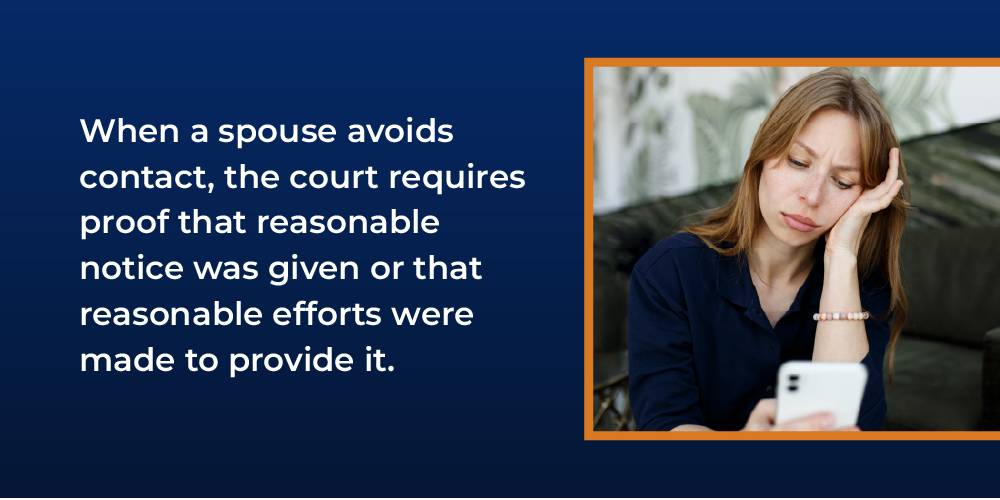
Some spouses choose to ignore divorce papers. They may think that if they do not respond, the divorce will go away. That is not how the process works in Illinois. Once your spouse has been properly served, he or she has a limited time to file an answer with the court.
If your spouse does nothing, your lawyer can ask for a "default" divorce. This means the judge may move forward without your spouse’s input. You will still need to appear in court, testify, and present basic evidence about your property, income, and children. The judge will review your proposed settlement or parenting plan and decide whether it is fair and follows Illinois law.
A default divorce does not mean you automatically get everything you want. The court still has a duty to divide marital property fairly and to protect the best interests of any children. However, your unresponsive spouse will lose the chance to advocate for themselves. This can make it easier to finish the case and move forward with your life, even if your spouse will not cooperate.
Divorce in Illinois is never as simple as filing and forgetting. There are a lot of extra steps involved that could make things more complicated than expected. Discuss your sensitive legal issues with a DuPage County, IL divorce attorney at Davi Law Group. Contact our firm at 630-657-5052 for a free consultation and evaluation of your unique circumstances.

2224 W. Ferry Road, Unit 113, | |
1776 S. Naperville Road, Building A, Suite 105, | |
321 N. Clark Street, Suite 900, | |
58 N. Chicago Street, Suite 102, | |
2407 West Lockport Street, Suite 201-H, |


 The use of the Internet or this form for communication with the firm or any individual member of the firm does not establish an attorney-client relationship. Confidential or time-sensitive information should not be sent through this form.
I have read and understand the Disclaimer and Privacy Policy.